
How to Lead a Business in the Age of AI
ten commandments

If you run a business, lead a function, or manage a team, you will make hundreds of small AI decisions over the next few years, and dozens of big ones. Which tools to buy, which workflows to redesign, which risks to tolerate, how to keep humans in the loop.
You will get a lot of these decisions wrong.
Everyone will. The technology is new, the tools keep changing, the models keep changing, the market keeps changing, and we’re all worried about being left behind.
Plenty of useful AI strategy writing already exists. Read it. Workflows, agents, governance, copilots, automation, model risk, transformation roadmaps, etc.. But I want to go one level up from all of that. I want to focus on this meta-question:
How do you become the kind of leader who makes more good AI decisions and fewer bad ones?
And I want to suggest that you start your journey with these ten commandments. At the end, I’ll give you a prompt you can use to customize them to your role and organization.
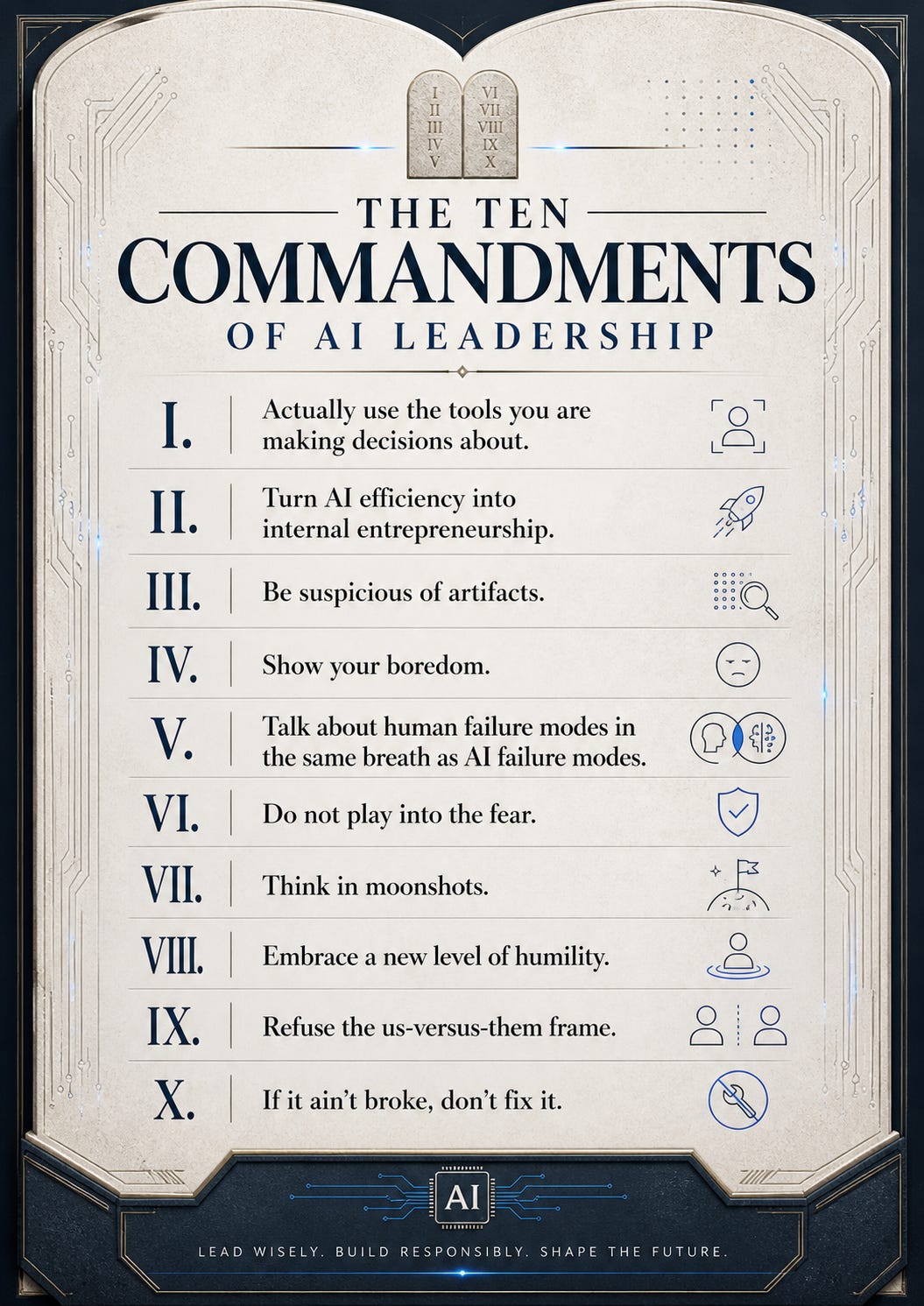
I. Actually use the tools you are making decisions about.
Many leaders are making important AI decisions based on hearsay. They look at adoption numbers, employee feedback, usage dashboards, vendor demos, and readouts from the AI team. Then they offer suggestions that basically boil down to: make the tool better, make it faster, tell people to use it, train people more.
That feedback is not always wrong, but it is often too far removed from workplace reality to be meaningfully useful.
If you are going to make decisions about AI tools, workflows, adoption, governance, training, or investment, you need firsthand experience using the tools in real work. Not every tool. But enough that you have a real feel for the thing. You need to know, from a first person perspective, what a good AI experience is and what a bad one is.
Firsthand use gives you vocabulary. Without it, you are trapped in abstractions. With it, you can go deeper on the use cases you understand and extrapolate more intelligently to everything else.
A practical move: get an AI mentor inside your company who is more junior than you but better at AI. Be clear about the role. They are not there to do AI tasks for you and email you the output. Their job is to teach you to do things yourself. That may feel uncomfortable. It’s still important.
II. Turn AI efficiency into internal entrepreneurship.
Companies have been talking about “innovation time” forever. 3M is the famous case study, the company long associated with letting employees spend a portion of their time on self-directed projects. Everyone loves the idea. Almost nobody makes it work. Too hard to govern, measure, track, and coordinate.
AI offers a chance to do this differently because it lowers the cost of trying things. If AI saves time, some of that time should become entrepreneurial capacity: small teams, real problems, fast prototypes, clear triage, useful failures, occasional wins.
You still need structure. A simple intake. A triage point. A place to showcase good work. A path for the best ideas to move into a product or build team. (AI can help with all of that!) But keep it light. This is about innovation, not administration.
This is also a more honest answer to the crudest AI efficiency math. The bad version: AI made us 15% more efficient, so we can cut 15% of our people. The better version: AI can make us more efficient if we actually work at it, and some of that efficiency should become structured internal entrepreneurship.
Cost discipline does not disappear. But the first question should not always be: who can we cut? Sometimes it should be: what can our people now build?
For access to this full article and all of my premium content, please consider supporting my work with a paid subscription.
Keep reading with a 7-day free trial
Subscribe to AI + IQ to keep reading this post and get 7 days of free access to the full post archives.