
How to Train Your Brain for AI
Plus, the ten hidden muscles your brain needs to prompt like a pro

Dear Prompt Experimenters,
I work with extremely intelligent and successful people.
Not slow learners. The opposite of slow learners.
But they see some of my more advanced AI prompts, and the reaction is tantamount to: “What kind of black magic is this?”
“It’s so long and complicated….and recursive.”
“I’m not sure my brain is wired to think like that.”
Etc.
These aren’t dumb people, by any definition. So why does advanced prompting feel so…inaccessible?
Two reasons, I think:
First: AI is new.
Most people started by treating it like Google: ask a question, get a fact. But prompting isn’t searching. It’s something else altogether.
Second: AI demands something we’ve never really been asked to develop before.
It calls on specific mental muscles which, even for many high-performers, are simply under-conditioned. Not because we’re incapable. But because we haven’t needed them. Until now.
Now, we need them.
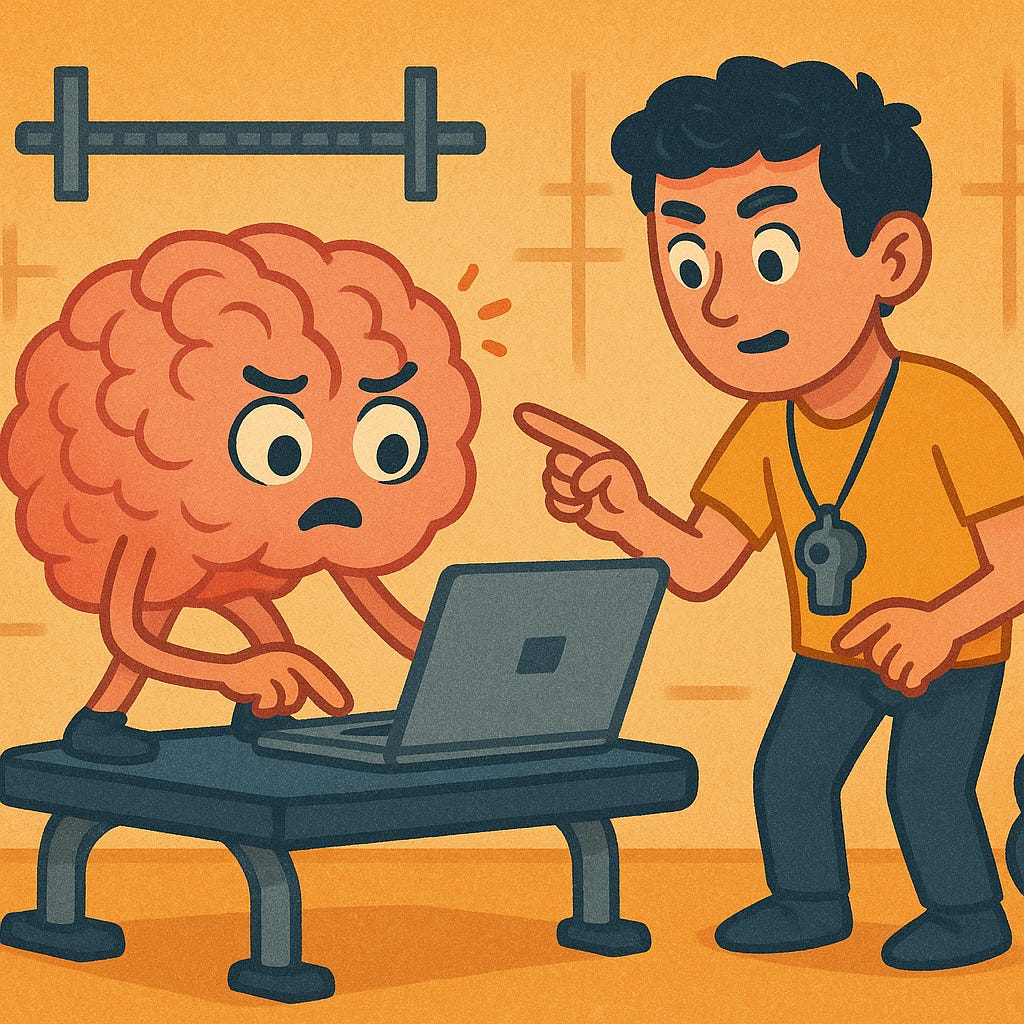
So let’s talk about that, understand what these mental muscles are, and how they work. Let’s talk about how to train them until they pop, until you are the AI god you were meant to be!
This article will contain the full “theory of the case,” available to all. Paid subscribers, please read all the way down for prompts that will deliver a personalized diagnostic assessment and interactive “prompt brain trainer” coach!
WHY AI IS DIFFERENT
Even the Smartest People Are Struggling
Most people assume prompting is just about learning to "talk to the machine."
Write clearer instructions. Add a few examples. Learn a few hacks.
But if you've ever tried to push beyond basic prompting, if you've tried to get the model to do something really sophisticated, you've probably felt it:
"Why can't I get the model to give me the thing I know it's capable of?"
Here’s why.
The Cognitive Stack You Were Never Asked to Build
If you’re a lawyer, consultant, founder, executive, or knowledge worker, you’ve likely spent your whole career developing sharp, high-performance cognitive skills:
Structured thinking
Judgment under uncertainty
Decision frameworks
Concise communication
Domain expertise
These skills have served you extremely well.
The problem is: AI requires a different layer of cognitive scaffolding, one most professionals have never needed to build.
For the first time, your internal language metabolism becomes a primary lever of productivity.
THE TEN COGNITIVE MUSCLES THAT DRIVE AI PROMPTING MASTERY
Here’s what’s actually going on under the hood. These are the 10 cognitive muscles your brain draws on when writing high-performance AI prompts.
1️⃣ Lexical Precision
Can you name things in one shot?
Are you able to collapse an entire complex idea into the right word or phrase ("counter-cyclical liquidity play" vs "good investment")?
🧠 Fuel Source: Vocabulary-rich reading; exposure to specialized, exact language across multiple fields.
2️⃣ Concrete Imagery & Sensory Anchors
Can you use vivid, specific details to ground the AI’s tone, emotion, or visualization?
The more sharply you describe, the more vivid the model’s output becomes.
🧠 Fuel Source: High-quality fiction, poetry, micro-description exercises.
3️⃣ Sentence Melody & Rhythm Control
Can you modulate the cadence of your language?
Are you able to ask for "staccato urgency" vs "long rolling sentences" — and generate examples to guide the model?
🧠 Fuel Source: Close reading of great stylists (Didion, Baldwin, McCarthy, Churchill).
4️⃣ Narrative Spine & Structural Thinking
Can you quickly sketch a problem as a two-line narrative arc?
Are you able to organize prompts into coherent narrative logic vs chaotic "topic soup"?
🧠 Fuel Source: Story structure guides, detective fiction, strong nonfiction case studies.
5️⃣ Argumentative Rigor & Dialectic
Can you scaffold claims, counter-claims, warrants, and counterpoints?
Are you able to instruct the model to steelman arguments before taking a stance?
🧠 Fuel Source: Essays, philosophy, debate structures.
6️⃣ Metaphor & Analogy Fluency
Can you generate vivid comparisons to make abstractions memorable?
Can you prompt the model with cross-domain analogies that unlock fresh outputs?
🧠 Fuel Source: Scientific nonfiction, literary essays, poetic metaphor drills.
7️⃣ Style-Shifting & Voice Mimicry
Can you adjust tone to match different voices?
Can you feed the model seed text that lets it mimic the mood you want?
🧠 Fuel Source: Wide reading across diverse authors and formats.
8️⃣ Interdisciplinary Concept-Splicing
Can you blend concepts from different fields to create unique angles?
Can you prompt cross-domain synthesis (“Apply ecological resilience to our hiring strategy”)?
🧠 Fuel Source: Big-idea synthesis books, cross-field interviews, interdisciplinary thinking.
9️⃣ Meta-Prompt Reflexivity
Can you read the model’s behavior and adapt your prompts accordingly?
Are you able to give the model "second-order" instructions about how to approach the task?
🧠 Fuel Source: AI interpretability writing, meta-prompting drills, iterative prompting practice.
🔟 Voice-and-Vision Synthesis (The "Badass Layer")
Can you co-create with the model as a true collaborator?
Can you actively jam with the AI in live writing, bending it toward originality?
🧠 Fuel Source: Live GPT co-writing, sentence-by-sentence writing jams, high-stakes generative exercises.
Paid subscribers, please read on for prompts that will deliver a personalized diagnostic assessment and interactive “prompt brain trainer” coach!
DIAGNOSTIC ASSESSMENT: Is Your Brain Ready for AI?
Are some of your own AI muscles under-developed? Let’s find out.
(And don’t worry. Everything we’re talking about is very much a learnable skill.)
I have a prompt diagnostic designed to reveal your current mental muscle profile, your current personal “prompting stack.”
Keep reading with a 7-day free trial
Subscribe to AI + IQ to keep reading this post and get 7 days of free access to the full post archives.